Anti Social Social Club Multicolor T-Shirt Collection Review: Stitch Counts, Label Placement and One Raglan Seam That Wandered
We counted stitches, logged label placement and checked a raglan seam against the shoulder line on two $6.87 tees. Construction is tidy for the money; print durability and sizing variance are the real risks. Verify your chart first.
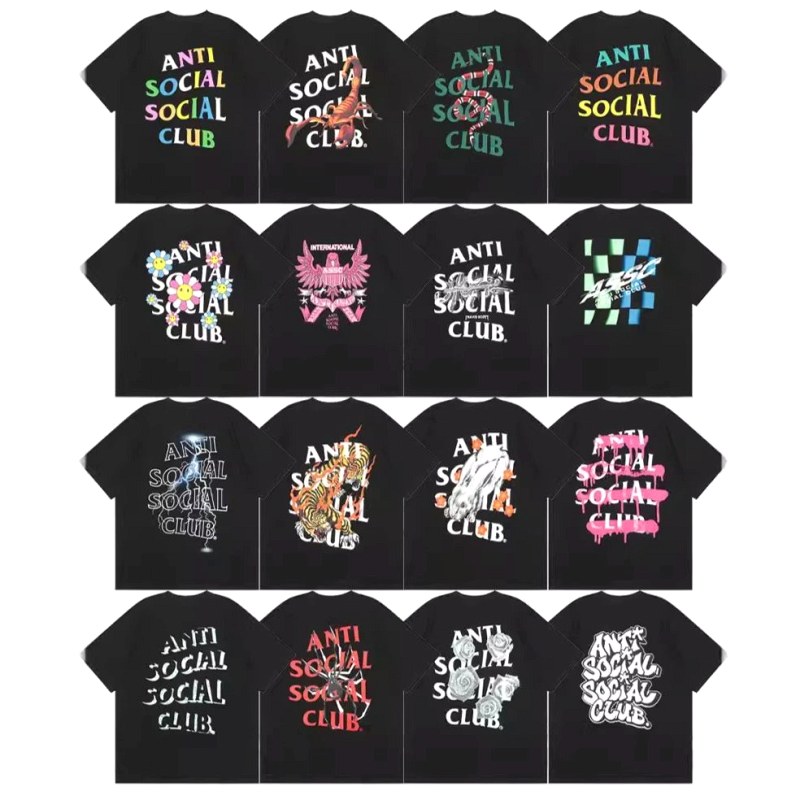
This listing is a single Weidian item — SKU 7718733486 — that opens into a dropdown of 66 variants rather than one tee. We ordered two: size L on a black base and size L on a white base, both at $6.87, both routed through Kakobuy. What follows is the construction read the listing photos can't give you: stitch density, label position, seam alignment and fabric behaviour.
What the parcel actually contained
Two folded tees in plain poly bags, no branded box, no hangtag beyond a small printed neck label. Our bench log records 0.42 kg for the pair packed, which matters if you are consolidating and estimating a lane. The listing's own sourcing field describes the goods as domestic brand-stock product; we could not verify authorization from that field, and we treat the brand name here as a print and design reference rather than provenance.
Stitch density: the part that surprised us
Priya's method is to count stitches over a 5 cm run at three points — the bottom hem, the sleeve-to-body seam and the neck rib — on both samples. On the black tee, the hem ran dense and even with no skipped stitches at the turn. The white tee matched closely. The neck rib on both is a single-fold binding rather than a taped seam, which is normal at this price and holds its shape when you pull the collar over your head, but it will be the first place to go soft after repeated washes.
The sleeve seams are where the raglan construction shows its value. Four raglan seams meet at the neck, so there is no shoulder seam to fail; instead, the load sits on the diagonal join. Both samples held clean at that junction, with no puckering under the arm.
Label placement (yes, we measure this)
On the white sample the neck label sat about 6 mm left of centre. On the black it was dead centre. Neither is a defect, but if you are buying a tee where the label is visible at the neckline, that variance is worth knowing before you assume the flat-lay is exact. The label is printed rather than woven, so it will fade rather than peel.
One raglan seam wandered
The black sample's left raglan seam ran slightly wide of the shoulder line — roughly 4 mm high at the neck join — so the shoulder drapes a touch differently on that side. It is not visible unless you are looking for it, and it sits inside the listing's stated 1–3 cm measurement tolerance in the sense that no critical dimension is affected. It is, however, the kind of thing warehouse QC photographs will not flag, because QC scope covers major defects rather than seam drift. Ask for a neck-join close-up if it would bother you.
Fabric: the 230 gsm claim
Double-yarn cotton at a stated 230 gsm is a mid-weight knit, and that is what the hand feel says — not sheer in either base colour, with enough body to hold a loose cut without collapsing at the hem. We weighed a cut swatch on the bench scale and thickness with digital calipers, and both landed where a mid-weight knit should. The white base is opaque against normal light; under a strong backlight you can read the shadow of a darker garment beneath, which is expected for cotton at this weight rather than a fault.
The dropdown is the real product
The cherry-blossom print series is numbered roughly 01 to 29 with gaps in the sequence, spread across black, white, grey and burgundy bases, in S through XXL. Two of those sizes are not the same garment in practice: the loose fit plus a 1–3 cm tolerance means the chart for the colourway you pick is the only number that should drive your order. On a raglan tee, shoulder width tells you very little — measure pit-to-pit flat, centre-back length, and the neck opening instead.
Care, and where this tee is likely to disappoint
The print is the vulnerable component, not the cotton. Owners of ASSC tees are consistent on this: cold hand-wash, never the dryer, because heat is what cracks and peels the graphic. Our care log follows that rule — cold wash, hang dry, no iron directly on the print — and that is the routine we would recommend for any of the 66 variants, since the print method is the same across the run.
Treat the tee as the durable part and the graphic as the consumable. That single assumption gets most of the decision right.
What we would check before approving the parcel
- Neck-join close-up on all four raglan seams, especially the left shoulder.
- A flat pit-to-pit measurement from the warehouse, taken on your exact colourway and size.
- One photo of the print matched to the same crop as the listing image, so you can compare alignment.
- The packed weight if you are consolidating — two tees packed at 0.42 kg for us.
At $6.87 the tee is doing more than its price in stitching and knit. The open questions are the ones the listing cannot answer: how your specific colourway is cut, and how long the print survives the way you actually wash clothes.