Represent Angel Graphic Tee Review: We Line-Dried Three Colourways to Test the Non-Iron Finish
We washed and line-dried three colourways to test the listing's non-iron finish. The cotton relaxed within hours, the cracked-print graphics held their creases longer, and sizing still belongs to the chart.
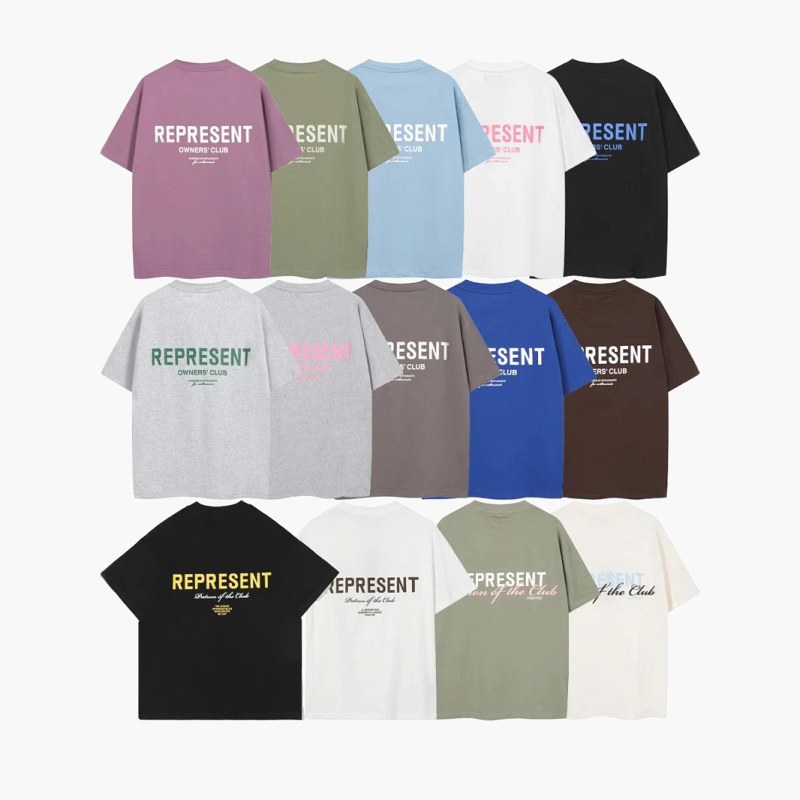
The listing calls this a collection, and the variant sheet backs that up: dozens of rows, most of them a solid body colour with a wordmark and small graphics on the chest, priced at $7.76 against a $9.26 original. What the spec block promises beyond the cotton is a non-iron treatment — the one line in the sheet we had not yet put under any real pressure. So this round we stopped counting colourways and started watching creases.
What we ordered and how we checked it
Our testing team placed a single order for three short-sleeve crew necks in size M: one base black, one R3021 distressed black-and-white, one R447 grey-brown. The parcel was photographed on the bench before opening, weighed against the quoted shipping line, and unpacked on a clean mat so the fold pattern from transit could be recorded first.
Priya then measured each tee flat — chest, body length, shoulder, sleeve opening and collar rib — and repeated the chest and length on the closest-fitting panel member. Stitch density was counted at the hem and the collar join, and label placement was logged on all three, since a printed neck label and a woven one sit differently against the skin. Then the tees went into the wash.
The non-iron claim, tested on a drying rail
All three were washed inside out at 30°C, which is the care guidance the brand publishes for its tees, and none went near a tumble dryer. They were hung on the same rail, in the same room, and photographed at two, six and 24 hours. We scored creasing on the body, the sleeve and the print panel separately, because that is where the results split.
| Area | 2 hours | 6 hours | 24 hours |
|---|---|---|---|
| Body and back panel | Soft fold lines along the packing creases | Mostly relaxed; hem line faint | Hang-dry smooth, no iron needed |
| Sleeve and shoulder | Visible crease at the sleeve head | Faded but readable | Gone |
| Print panel | Sharp creases across the wordmark | Still visible at an angle | Softened, not fully flat |
That is a genuine result for a $7.76 cotton tee. The jersey behaved the way a treated combed cotton should: it let go of the fold lines without heat, and the 180–250gsm band the sheet quotes feels honest against our own hand — light enough for July, not so thin that the print reads through to the back. The caveat is that the treatment works on the fabric, not on the ink. The printed area is stiffer than the cotton around it, so it holds a crease longer and needs either more hang time or a low iron through a cloth.
Measurements, labels and stitching
Our three size M tees came out consistent with each other, which matters more than the absolute numbers when a listing carries this many variants — a body that varies between colourways is the usual failure mode on multi-row listings. The cut is loose through the chest and straight to the hem, with a crew rib that sat flat after washing on all three. Stitch density at the hem was clean and even; the collar join was the looser of the two, and it is the seam we will watch at the nine-month retest.
Sizing remains the honest sticking point. Community reports describe Represent tees as roomy, and several buyers take a size down, but at least one reviewer who sized down found the fit tight. We did not find a clear rule, so treat the chart as the only reliable guide and measure a tee you already like.
The print is the part with a clock on it
Each piece will age uniquely — cracked print may lose ink over time.
That sentence comes from the brand itself, and it is the single most useful thing to know before ordering. The distressed variants in our order are designed to look worn from day one; the solid base colours are not, and they will still drift toward the same cracked finish. We are not calling that a defect, because the brand states it plainly. We are calling it a purchasing decision: if you want a graphic that stays crisp, this is the wrong tee, and no amount of careful washing will change the ink's trajectory.
Cost, route and what we would change
At $7.76 the tee is the cheap part of the order. The real spread is in the variant sheet — dozens of codes across solid tones, distressed washes and numbered graphic sets, one tee per order — so the practical cost is the time you spend picking a row and the risk of picking the wrong one. Read the image group for your chosen code rather than the first photo, and confirm the measurements attached to that option before you commit. Parcel weight came in close to the carrier quote, and QC photos matched the listing crops at the same framing, which is the outcome we want on a low-value order.
Nine months from now we will re-wash the same three and see whether the print panel has cracked further than the brand's own warning suggests. That is the number we actually want.