bestkako Shoe Brush Arrival Checklist
bestkako Shoe Brush Arrival Checklist
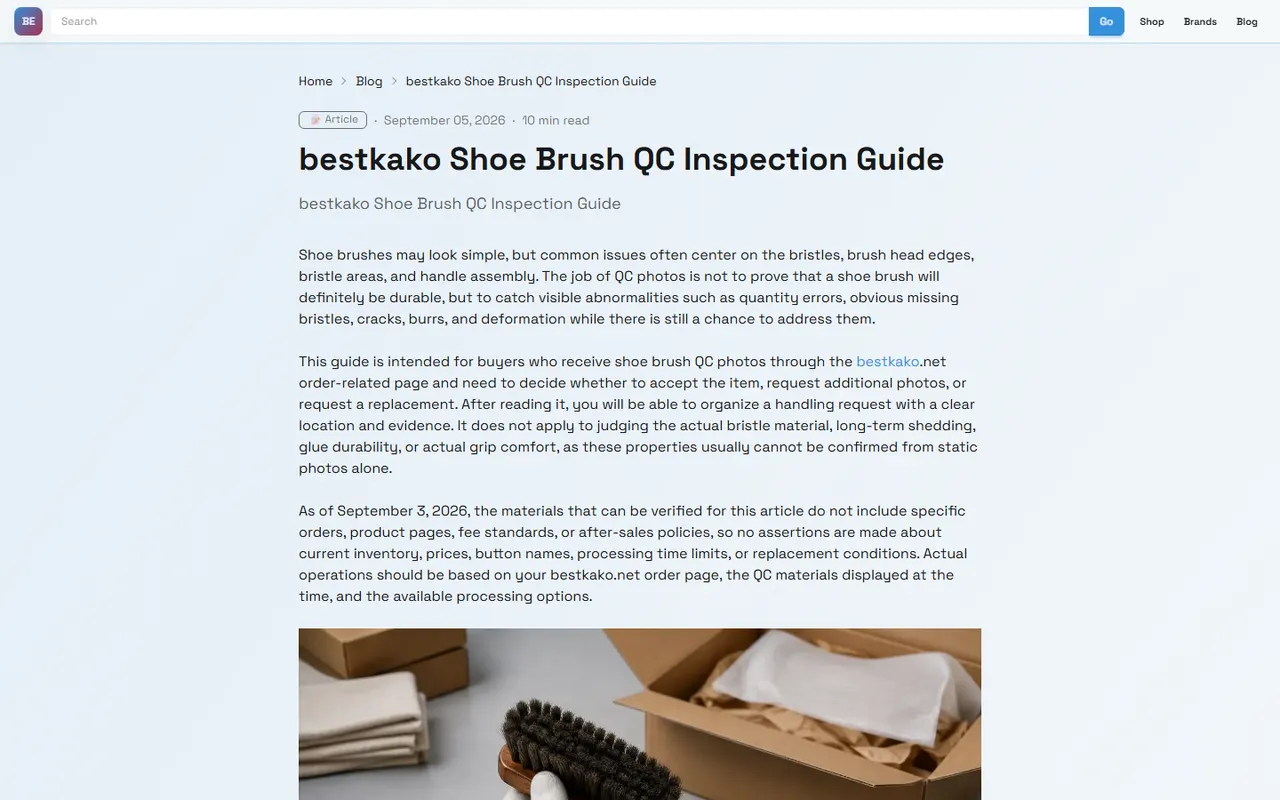
When you receive the shoe brush from your bestkako order, don't rush to throw away the packaging or confirm receipt. A more cautious approach is to record the order information, actual quantity, style, accessories, and packaging condition in a single table. That way, whether you discover missing pieces, wrong styles, or need to contact the seller, you can quickly provide clear evidence.
This article only handles one specific task: checking whether the shoe brush and its included items match the order, and establishing a traceable receiving record. It does not apply to judging the authenticity of bristle material, long-term durability, cleaning effectiveness, or suitability for special shoe uppers. The specific product types and page information on bestkako.net should be based on the currently accessible content on the site and your order records. This record only applies to the shoe brush actually purchased in your order.
First confirm the range of shoe brushes and accessories that should arrive in the order
Open the order details, product page, or warehouse inbound record, and first write down what you theoretically should receive. Do not rely solely on memory to judge whether "one shoe brush" means a single item, because the same order may contain multiple quantities, different styles, or a combo set.
It is recommended to first record these fields:
Order number or internal order identifier. When sending screenshots externally, you should cover unnecessary personal information.
Product name and the style name displayed on the page.
Purchase quantity.
Whether it is a single item, set, combo, or multi-variant order.
Accessories explicitly listed on the page, such as brush cover, lanyard, packaging box, or instruction materials.
The color, size, handle version, or other variants selected at purchase.
Number of packages and inbound date.
If the product page does not explicitly state a certain accessory, do not directly list it as "missing." You can first mark it as "not stated on page" and wait for order details, packing list, or seller reply for further confirmation.📦
Build a receiving checklist from bestkako product information
When building a checklist, it is best to separate "what should arrive" from "what actually arrived." This avoids modifying expectations after seeing the actual items, and preserves the basis for judgment.
You can use the following fields in Google Sheets or other spreadsheets:
Order identifier
Product name
Style or variant shown on the product page
Expected quantity
Actual quantity
Expected accessories
Actual accessories
Quantity status
Style status
Packaging status
Evidence photo number
Processing status
Remarks
For quantity status, you can uniformly use "Match", "Short", "Over", "Pending Confirmation". For style status, use "Match", "Wrong Style", "Unable to Determine". For packaging status, use "Intact", "Outer Packaging Damaged", "Product Packaging Damaged", "Main Body Suspected Damaged". With unified wording, it will be more convenient to filter pending items later.
When recording, do not write "Match" just because it "looks like the same style." If the color, size, brush head shape, or handle label cannot be confirmed from photos, use "Pending Confirmation" first.
Use Google Sheets to record quantity, style, and missing status
The table doesn't need to be complicated, but each row should correspond to one verifiable object. For a set containing multiple shoe brushes, you can have each brush occupy its own row, and add another row for the set's accessories as a whole.
For example:
First row records shoe brush main body A, with expected 1, actual 1.
Second row records shoe brush main body B, with expected 1, actual 0, and mark "Short".
Third row records the packaging box, entering "not stated on page" or the explicit quantity from the order.
Fourth row records other included items, noting whether there is independent evidence.
To preserve traceability, photo numbers can use a simple format, such as "20260917-01", "20260917-02". Keep the photo filenames consistent with the table as much as possible, to avoid saving only one image that cannot distinguish content.
Do not publish the order number, delivery address, phone number, payment information, or full shipping label to a public spreadsheet. When providing feedback to the seller, only provide the fields necessary to identify the problem, and cover irrelevant personal information.🔒
Check item by item according to packaging layer, main body, and attached accessories
It is recommended to check in order from outside to inside to avoid missing small accessories inside the packaging.
The first layer is the shipping packaging. Record whether the outer box or courier bag has holes, obvious squeezing, moisture, resealing, or abnormal labels. Damage to the outer packaging does not mean the product is already damaged, but it may affect subsequent responsibility judgment, so you should take photos before opening.
The second layer is the product packaging. Check the packaging quantity, labels, seals, and internal compartments. If multiple shoe brushes are packed in the same box, first confirm whether the packaging markings support quantity judgment; do not infer how many should be inside just from the box size.
The third layer is the shoe brush main body. Count each item, and separately record the visible style, color, size, or other order variants. Do not only take a photo of the whole box, because a whole-box photo usually cannot prove the details of each piece.
The fourth layer is attached accessories. Check off each accessory explicitly listed in the order. For items not explicitly listed, you can record them as "found in package" or "not stated on page", and do not arbitrarily judge that they are standard configuration of the product.
If the product surface has dust, slight packaging friction, or shipping marks, record the condition first, and do not wipe away possibly useful evidence just for a photo.🧾
Distinguish among three types of problems: missing, wrong style, and packaging damage
These three types of problems require different evidence, and mixing them can lead to unclear feedback.
Missing is when the expected quantity is higher than the actual quantity, or an accessory explicitly listed in the order is not found. The core evidence is the expected quantity in the order, the complete layout photo after opening, and the item-by-item count result.
Wrong style is when the quantity may match, but the color, size, style, or variant differs from the order selection. The core evidence is the order selection page or order record, as well as photos of the physical label, overall appearance, and key details.
Packaging damage is when the outer packaging, product packaging, or main body shows breakage, compression, cracks, deformation, or other visible problems. The core evidence should include an overall photo before moving, a close-up photo of the damaged area, and photos showing the packaging layers.
If the same item has both wrong style and damage, record the two statuses separately, and do not just write "has problem". With clear classification, the seller can more easily determine whether to resend, exchange, refund, or continue verification.
Preserve evidence with panoramic and close-up photos
A practical set of photos should cover at least the following:
Package exterior and shipping label, covering address, phone number, and full order number if necessary.
A panoramic view of all items after opening, to prove the total actual quantity.
Individual photos of each shoe brush main body, to identify quantity and style.
Close-up photos of labels, variant markings, or packing list.
Detail photos of missing item locations, damaged areas, or suspected wrong style details.
If needed, take photos of the inside of the packaging to show that accessories are indeed not inside.
Photos should be taken in a stable lighting and clean background environment. Panoramic photos explain "what items are there", and close-up photos explain "exactly where the inconsistency is". Do not alter the product appearance through cropping, filters, or editing; only perform necessary privacy covering, and keep the unprocessed original photos.
If using photos taken by a platform warehouse, record the photo source and shooting time as well. Warehouse photos can only prove the content visible in the photo, and cannot automatically prove that an accessory not appearing in the image is definitely missing.
Which situations require additional information before making a judgment
In the following situations, do not directly conclude missing or wrong style:
The product page does not explicitly list included accessories.
The order shows a combo set, but the page does not specify the quantity of each component.
Accessories in the image may just be display props, and the page text does not confirm they are included.
Multiple styles share the same packaging, and the label cannot correspond to a specific variant.
Photos do not cover the inside of the packaging, so it cannot be ruled out that accessories are hidden in a compartment or separate bag.
The product quantity differs from the order quantity, but the package may arrive in separate shipments.
The shipping packaging is damaged, but whether the main body and accessories are affected cannot be determined for now.
These situations can be marked as "Pending Confirmation", and write clearly in the remarks what information is missing. Pending Confirmation does not mean there is no problem, but rather that current evidence is insufficient to complete a conclusion.
Organize necessary fields before providing feedback to the seller
Before contacting the seller, compress the information into an easy-to-check structure:
Order identifier and product name.
Expected quantity, actual quantity, and difference.
Style selected in the order vs. style actually seen.
Missing or suspected incorrect accessory names.
Whether packaging is damaged, and at which layer the damage occurred.
Corresponding photo numbers.
The specific question you want the seller to confirm.
The feedback should describe facts, and not use unprovable conclusions. For example, you can write "Order record shows expected 2 items, and 1 item is visible in the opening panoramic photo, photo number 20260917-01", rather than directly writing "warehouse missed one item". The former is easier for the other party to review and leaves room for subsequent handling.
If you need to send screenshots, first check whether they include delivery address, phone number, payment card information, full shipping label, or other irrelevant personal data. Only keep the parts that prove the order and product condition.
Next step: complete the receiving record and retain pending items
After completing the check, finalize the status of each object, and save the order page screenshot, original photos, and spreadsheet version. For "Match" items, you can mark them as completed; for "Short", "Wrong Style", "Packaging Damage", and "Pending Confirmation" items, keep them in pending status, and do not close them early just to make the table look tidy.
The product types on bestkako.net should be based on the current site catalog and actual orders. Even if the website has other categories, you cannot apply the accessory rules of other products to shoe brush orders. The applicable scope of the current record is: you have received a package related to a shoe brush and want to check the quantity, style, accessories, and packaging evidence.
The direct benefit of completing this record is reducing the time spent searching for orders and retaking photos later, and allowing the seller to locate problems faster. The cost is spending a few extra minutes during unboxing to count item by item, take photos, and fill in the table. It is suitable for people who need warehouse inspection, confirmation before combining packages, or keeping records for after-sales. If the package is already lost, there is no order record, or photos cannot cover key content, this method can only help organize existing evidence and cannot replace logistics investigation or seller confirmation.
Frequently Asked Questions about Agent Platform Shopping
1. What types of products can be purchased on bestkako.net?
bestkako.net offers a very wide variety of products, covering shoes, T-shirts, sweaters, hoodies, jeans, sweatpants, shorts, beach shorts, factory clearance items, down jackets, baseball jackets, shirts, hats, jewelry, bags, electronics, sunglasses, socks, underwear, and trendy collectibles.
Browse our latest products and find your next favorite item.