bestkako Shoe Brush QC Inspection Guide
bestkako Shoe Brush QC Inspection Guide
Shoe brushes may look simple, but common issues often center on the bristles, brush head edges, bristle areas, and handle assembly. The job of QC photos is not to prove that a shoe brush will definitely be durable, but to catch visible abnormalities such as quantity errors, obvious missing bristles, cracks, burrs, and deformation while there is still a chance to address them.
This guide is intended for buyers who receive shoe brush QC photos through the bestkako.net order-related page and need to decide whether to accept the item, request additional photos, or request a replacement. After reading it, you will be able to organize a handling request with a clear location and evidence. It does not apply to judging the actual bristle material, long-term shedding, glue durability, or actual grip comfort, as these properties usually cannot be confirmed from static photos alone.
As of September 3, 2026, the materials that can be verified for this article do not include specific orders, product pages, fee standards, or after-sales policies, so no assertions are made about current inventory, prices, button names, processing time limits, or replacement conditions. Actual operations should be based on your bestkako.net order page, the QC materials displayed at the time, and the available processing options.
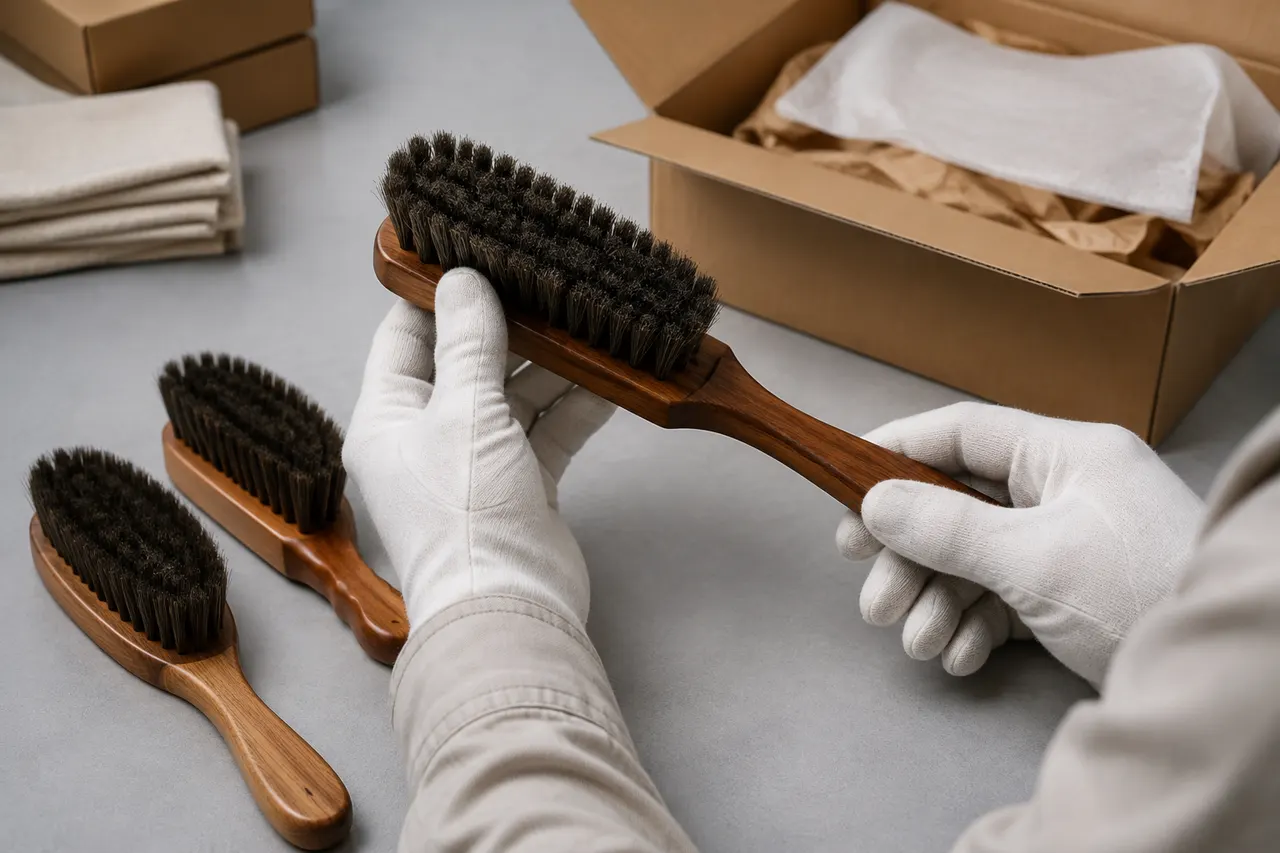
Shoe Brush QC Inspection Key Points Diagram
First Determine Shoe Brush Inspection Focus Based on Cleaning Purpose
Before looking at the photos, go back to the product specifications or order records to confirm the intended use of this brush. Different uses correspond to different priority inspection items:
For brushes used to remove dust from shoe uppers, prioritize checking whether the bristle coverage is even, whether there are large missing bristle areas, and whether the brush head is visibly deformed.
For small brushes used for edge and seam cleaning, focus on confirming whether the brush head width, tip shape, and bristle placement in narrow areas match the selected style.
For stiff-bristle brushes used for stronger cleaning, check whether the bristle bundles are skewed over a large area, and whether there are visible cracks at the connection between the handle and brush head.
For brush sets, first check the quantity, size, and style combination, then the workmanship of each piece.
Don't just ask "Does it look good?" A more effective question is: "Will this visible difference hinder me from cleaning the designated spot?" This helps avoid mistaking normal slight tip differences for defects, and also reduces missing issues that truly affect use. 🔎
Confirm Brush Quantity and Style Correspondence from Overview Photos
Look at the overview photo first, not zooming in on one tuft of bristles. Compare with the product name, specifications, color, and set quantity in the order, and confirm each item one by one:
Whether the number of shoe brushes visible in the photo matches the order.
Whether long handle, short handle, round head, narrow head, and other styles correspond to the selected specifications.
Whether different brushes in the same set can be distinguished by size or outline.
Whether there is an obvious wrong color, wrong style, or whether multiple angles actually show the same item.
If the packaging label is visible, whether its information matches the order record.
If the overview photo crops off the brush head or handle end, a complete quantity and shape check cannot be done. In that case, request a supplementary photo showing all shoe brushes in the same frame without overlapping each other. Do not assume the package contains everything based on its size.
Use Side Close-up Photos to Check Bristle Evenness and Obvious Gaps
Bristle inspection requires both front and side angles. The front is good for seeing coverage, and the side is easier for spotting local collapse, abnormally long bristles, and whole tufts skewed. 📏
Visible abnormalities typically include:
Clearly bounded holes in the bristle area where the base of the brush body is directly visible.
One or more tufts significantly lower than the surroundings, forming a notch that affects the contact surface.
Large areas of bristles leaning in different directions, rather than slight bends caused by shipping compression.
Individual bristles sticking out abnormally, with length differences enough to affect the overall contact surface.
Clearly visible foreign objects in the bristle area of unknown origin.
A slight unevenness in bristle tips does not automatically equal a quality problem. QC photos can also be affected by shooting angle, shadows, transparent packaging, and shipping compression. If a suspected gap appears in only one angle, request a supplementary close-up of that area from the side, with the bristles unobstructed.
When requesting supplementary photos, it's best to specify the location, for example, "the bristle area at the upper right of the brush head when the handle is down," rather than just saying "the bristles are uneven." Clear location reduces the chance of photographing the wrong spot.
Check Brush Head Edges, Bristle Area, and Bonding Areas
The brush head is responsible for fixing the bristles and transmitting cleaning force, so check the entire outer edge. Look mainly for chipped edges, obvious cracks, delamination, lifting, and abnormal seams.
Regular structure around the bristle holes is not necessarily a defect, but the following situations warrant further confirmation:
Multiple consecutive empty bristle holes forming an obvious gap band.
Large areas of bristle tuft bases at uneven heights, possibly not fixed in place.
Cracks extending from the edge, not just surface texture.
Clearly open seams or partial separation at joints.
Visible glue overflow over a large area and contacting the bristle working surface.
Seeing glue marks in a photo alone cannot conclude insufficient bonding strength; similarly, not seeing glue does not mean other fixing structures were not used. The correct approach is to record the visible phenomenon, not to judge the manufacturing process for the seller. 🧩
Check Handle Cracks, Burrs, and Obvious Deformation
Have the handle fully shown in the frame, and try to view the front, back, sides, and end. Acceptable surface texture and defects that affect safety or grip should be judged separately.
Prioritize:
Cracks extending inward from the edge and visible at different angles.
Sharp burrs protruding from the handle sides or around the hanging hole.
The handle as a whole bent, twisted, or the brush head and handle axis clearly off.
Wooden handle showing obvious splitting or raised fragments.
Plastic handle with missing corners, deep dents, or suspected stress whitening areas.
Whether color shade, natural texture, or light surface marks are acceptable needs to be judged in combination with the product description and intended use. Photos cannot prove whether a burr is sharp, so if a protruding edge is found, request closer, clearer photos from multiple angles; do not ask staff to touch suspected sharp parts with bare hands.
How to Compare Left and Right or Identical Shoe Brushes Side by Side
If the order includes two identical shoe brushes, side-by-side comparison is usually easier to spot abnormalities than viewing individually. When comparing, ensure both items are in the same orientation and at similar distance from the lens, to avoid perspective making one look larger or smaller.
Compare in order: brush head length, bristle coverage, bristle outline, handle curvature, and hanging hole position. Slight asymmetry may come from placement angle or manufacturing tolerance. What truly warrants handling are clear, concentrated, and potentially use-affecting differences, such as one having continuous missing bristles and the other not; one handle obviously twisted; or significant inconsistency in the shape of identical brush heads.
If the two brushes in the photo overlap each other, request one top-down photo and one side photo, and ask for them to be placed parallel. Do not use screen pixels to directly convert to actual dimensions unless there is a reliable size reference in the same plane within the photo.
Which Details Cannot Be Concluded from QC Photos Alone
QC photos are good at recording visible conditions, but cannot replace material testing or long-term use. The following should not be concluded hastily from photos:
Whether the bristles are natural hair, synthetic fiber, or a blend.
The actual softness/hardness, resilience, and whether they will scratch specific shoe uppers.
Whether shedding, glue failure, or deformation is likely after use.
Handle grip, slip resistance, and comfort during long use.
Odor, moisture content, cleaner compatibility, or material safety.
Whether colors that look the same in photos are exactly identical under natural light.
Also, do not ask warehouse staff to perform tests that could damage the product, such as pulling bristles, bending the handle, or wetting it. If material or applicable shoe upper is a core factor in the purchase decision, check the clear specifications on the product page; if the page does not state it, treat it as unconfirmed information rather than guessing based on appearance. ⚠️
Complete Processing by Categorizing as Acceptable, Supplementary Photos, or Replacement
After inspection, classify conclusions into three categories, avoiding mixing vague opinions in a single request.
Acceptable: Quantity, style, and main structure correspond to the order; no clear visible abnormality affecting use or safety is seen. This conclusion only means no problems were found in the existing photos, not a guarantee of durability.
Supplementary photos needed: Photos are cropped, blurry, blocked, or insufficient angle, making a specific suspicion unconfirmable. The request should specify the item, part, suspicion, and required angle, for example: "Please take a close-up without packaging of the left edge of the brush head when the handle is down, and add a side view, to confirm whether it is shadow or missing bristles."
Consider replacement: Photos clearly show wrong style, missing parts, large missing bristle areas, through cracks, sharp burrs, or obvious structural deformation. When submitting a handling request, describe only the visible evidence and attach marked locations; whether replacement conditions are met and available options should be based on the current order page and applicable rules.
Before final decision, do a brief review:
Order specifications correspond to quantity and styles in photos.
Bristles, brush head, and handle each viewed from at least one complete angle.
Each suspicion has a clear location, not relying on subjective words.
Material and durability that cannot be confirmed from photos are not written as facts.
Handling request does not include full address, payment information, or other unnecessary personal information.
This inspection itself cannot calculate a fixed savings amount, as product prices, reshooting fees, return/exchange costs, and logistics conditions are not verified. It may help buyers spot obvious problems before shipping, thereby avoiding further transportation costs for shoe brushes that do not meet needs; the added risk is that reshooting or processing may extend order progress, and over-amplifying normal appearance differences may also cause unnecessary replacements. This method is suitable for buyers who value quantity, style, and obvious assembly condition; if your decision mainly relies on bristle softness/hardness, actual cleaning effect, long-term shedding, or grip experience, it is not recommended to make the final quality judgment based only on QC photos. ✅
Common Questions About Agent Platform Shopping
1. On bestkako.net, how do I handle a purchase that does not meet my expectations?
Reach out to the customer service team at bestkako.net without delay. Many Chinese merchants provide a 5-day unconditional return and exchange window for most items that are not classified as special. If you are unhappy with your order, you may ask for a return. When the package has already been shipped from the warehouse and delivered to you, and you later identify a manufacturing defect or quality concern, contact bestkako.net's support staff. They will assist in communicating with the seller to work out a suitable compensation arrangement.
Customer service email addresses by platform are listed below:
kakobuy: [email protected]
oopbuy: [email protected]
usfans: [email protected]
hipobuy: [email protected]
superbuy: [email protected]
2. Which product categories can be browsed on bestkako.net?
bestkako.net presents a broad selection across numerous categories: sneakers, tees, knitwear, pullover hoodies, denim pants, joggers, shorts, swim trunks, stock clearance pieces, padded jackets, baseball jerseys, button-down shirts, caps, accessories like jewelry, handbags, gadgets, sunglasses, socks, underwear, and fashionable collectible items.
3. Can you explain what QC photos are in the context of bestkako.net?
Each drop-shipping service, including bestkako.net, has a specialized quality control department. After your purchased goods are received at the bestkako.net warehouse, staff perform a thorough inspection and capture QC photographs of your products. Typically they take three photos, and the inspectors check that the color, size, specifications, and quantity correspond to your order. They also look for any potential defects. Electronic goods are an exception; for those, only the external appearance is examined. If a problem is found such as incorrect size, wrong color, or a quality flaw, the team will immediately arrange a return to the seller. This process helps guarantee that you receive items in good condition.
Browse our latest products and find your next favorite item.